


Our green credentials.
Defining sustainability.
The dictionary defines "sustainable" as something that is "made in a way that causes little or no damage to the environment and therefore able to continue for a long time". In recent years, this word has become widely used as a way of speaking about environmental impact, with the more specific definition “causing, or made in a way that causes, little or no damage to the environment, and therefore able to continue for a long time.”
This is the definition our customers use, and it’s the definition we use.
This means we don't just focus on one narrow part of making Naked Paper. We monitor and work to reduce our environmental impact across several key areas: our CO2e emissions, our raw materials, and our social impact. We also seek external certification from trusted international bodies and provide proof of our claims, so customers can judge our impact for themselves.
Evidencing our claims - index
Key claims
- Why is toilet paper white?
- It's brown because it's greener
- The UK's most sustainable toilet roll | The UK's most eco friendly toilet roll
- Better for the planet | Gentler on the environment | Loo roll that doesn't cost the earth
- Smaller climate footprint than other eco brands
- No bleach
- No harsh chemicals
- No plastic
- Trees and toilet paper
- The UK's highest rated eco loo roll
- Rated No.1 eco toilet roll by Ethical Consumer
- Carbon cuts, not carbon credits
Product claims
- FSC certified bamboo and recycled materials (C109654)
- Food safe certification
- PFAS free
- BPA free
- REACH certification
- Wet strength and disintegration test
- Packaging made from 100% recycled material
- Vegan glue
- Eco-friendly ink on our boxes
- Bamboo is grown without any fertilisers or pesticides – Supplier 1 and Supplier 2
- Roll Cosy is made from Fairtrade organic cotton, using REACH-compliant inks, in collaboration with Bags of Ethics.
Factory claims
- Manufactured using 100% renewable energy
- Fossil fuel free factory
- No unnecessary waste
- 8,000 onsite solar panels
- Award winning energy innovations
- Water returned to the river in same condition it was taken
- Patented system to recirculate heat, reducing energy use significantly
- Highest rated B Corp tissue factory
- ISO 14067 CO2 footprint
- ISO 50001 Energy Savings
- ISO 14001 Environment
Climate footprint / emissions claims
- ISO 14067 lifecycle assessment
- Product climate footprint
- Carbon footprint standard
- CO2e assessed product
- Science based emissions reduction targets (SBTi)
Raw materials claims
Other claims
- The average person uses 127 toilet rolls per year
- Paper making is traditionally powered by fossil fuels
- Normal toilet paper and household tissue products wipe out nearly 1m trees per day (345m a year)
- Most of the energy in paper making is used to generate the heat that dries the pulp
- Normal tissue products contain harsh chemicals
- Price comparison | Best priced eco toilet roll
- How we calculate our savings
- How much paper is saved by not wrapping our rolls
- Printed marketing materials
- Our green claims policy
- Registered trademarks
Why is toilet paper white?
Toilet paper doesn't need to be bright white to do its job. White has long been an established consumer expectation in the mainstream tissue market and has been associated with perceptions of cleanliness.
A US Environmental Protection Agency market study found that mainstream consumers demanded bright white tissue. One tissue manufacturer explained that “clean and sanitary translates to white”, while distributors reported that mainstream consumers perceived unbleached toilet tissue as not looking as “clean” because of its colour.
Naked Paper chooses not to bleach its toilet paper, which is why it retains its natural unbleached colour.
Evidence: U.S. Environmental Protection Agency (1992), Market Study of Molecular Chlorine-Free and Totally Chlorine-Free Bleached Paper, Chapter 4, pp. 4-18–4-19. View the evidence.
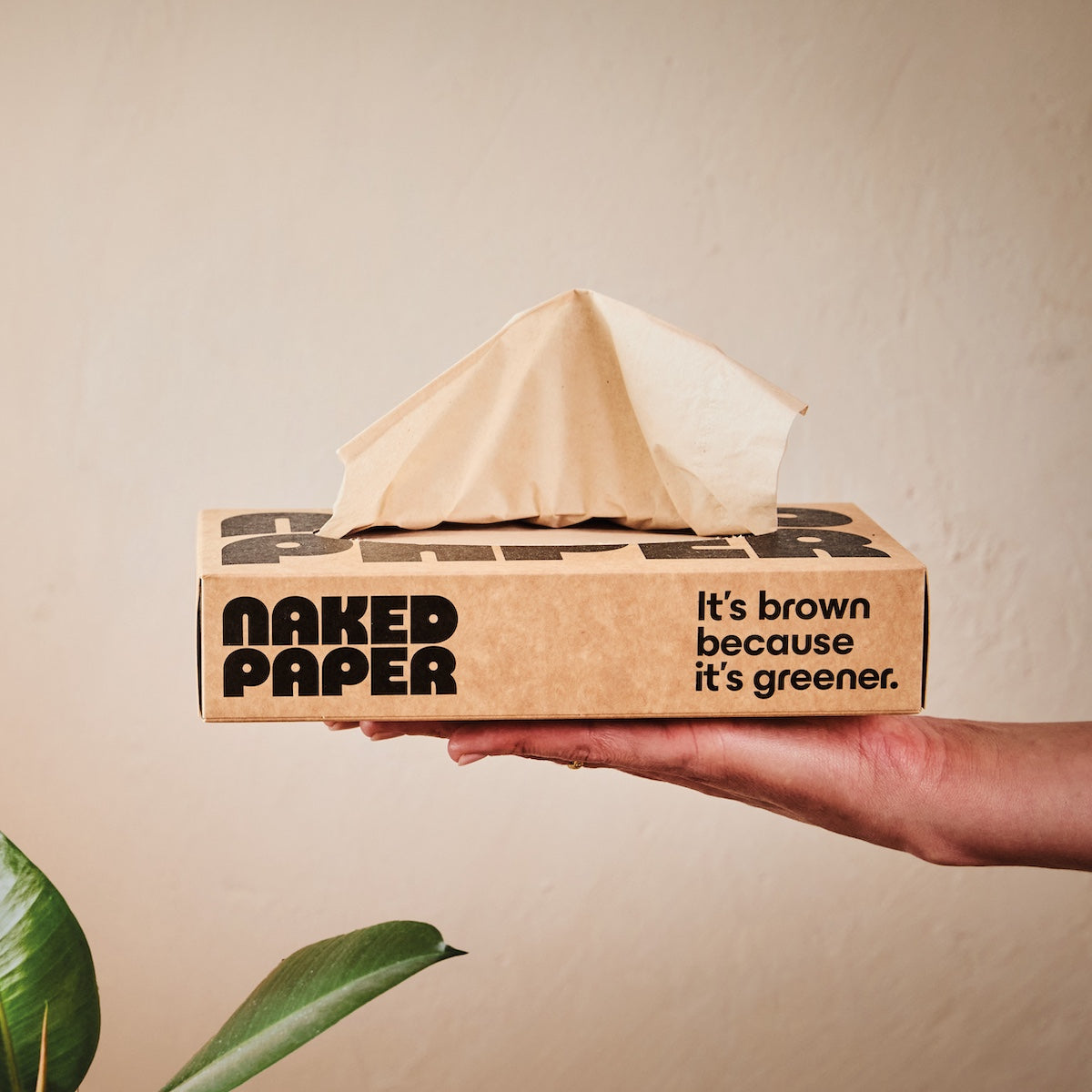
It's brown because it's greener.
Most conventional tissue is bleached, a process that requires extra chemicals, energy and water. Our LCA shows that by skipping this step, our unbleached rolls have a lower footprint across multiple impact categories compared to standard white tissue. That’s why we describe them as kinder to the planet. Or as we like to say: We didn’t make it brown. Nature did.
Bamboo is also different from trees used for virgin wood pulp. When mature bamboo stems are harvested, new stems can grow from the plant's established underground rhizome system. This means bamboo can regenerate after harvesting without ordinarily needing to be replanted each time.
Evidence: FAO, Bamboo Silviculture. View the evidence.
1. Reduced Chemical Pollution
The bleaching of paper, especially using chlorine based chemicals, releases harmful substances like dioxins and furans. Persistent organic pollutants (POPs) that accumulate in the environment and can be toxic to human health. Studies have shown that:
- The bleaching process in kraft pulp mills accounts for 80-90% of the total chemical releases into the environment. (NCASI Report)
- Chlorine bleaching creates toxic byproducts, including dioxins, which both the Environmental Protection Agency (EPA) and the United Nations Environment Programme (UNEP) have identified as serious environmental risks. (EPA) (UNEP)
- Scientific research shows that Elemental Chlorine Free (ECF) and Totally Chlorine Free (TCF) bleaching methods reduce pollutants but do not eliminate them entirely. (Confederation of Paper Industries)
- Dioxins and furans from chlorine bleaching are among the most toxic environmental pollutants, according to studies published in Environmental Science & Technology and PubMed. (Environmental Science & Technology Study) (PubMed Study)
By manufacturing our unbleached tissue products, we avoid introducing these harmful chemicals into waterways and ecosystems.
2. Lower Energy and Water Consumption
Bleaching requires additional energy and water to remove lignin, the natural component that makes paper brown. Research indicates that:
- A Life Cycle Assessment of toilet paper production found that the bleaching process significantly increases energy and water consumption. (LCA Study)
- The bleaching process adds significantly to the climate footprint of both ECF and TCF bleached pulp products. (Environmental systems analysis)
- Reducing or eliminating bleaching in tissue production lowers the overall environmental impact, conserving valuable resources like water and energy.
3. Biodegradation
Naked Paper toilet paper and packaging is made from biodegradable materials (Biodegradability report).
- Studies on paper biodegradation rates show that unbleached paper releases less CO₂ as it decomposes, indicating a more environmentally friendly breakdown process. (Waste Management Research Study)
The UK's most sustainable toilet roll
Below is a detailed comparison evidencing our claim to be “The UK’s most sustainable toilet roll.”
When we talk about being "best eco loo roll," "best sustainable loo roll," "better for the planet," "gentler on the environment," "greener," "loo roll that doesn't cost the earth" or similar, we are referring to being a more sustainable choice than other eco toilet roll brands, as evidenced in the below tables. This also applies when we say our paper is "made better - for the planet, for everyone."
Our commitment to sustainability is reflected in every part of our process, from reducing chemical pollution and lowering energy and water consumption to ensuring our products biodegrade efficiently. It’s why we call our products "uncompromisingly sustainable paper", because we don’t cut corners when it comes to protecting the environment and creating a truly sustainable alternative.
The claim "best toilet paper delivery" is also evidenced in the below table.

